
Most approaches that reach a family are honest. Someone's aunt knows someone, a friend passes on a name, a relative suggests a call. But because biodata travels freely in chats and groups, a small number of people use it for the wrong reasons: to collect personal details, to ask for money, or to waste a family's time.
You do not need to be suspicious of everyone. You only need to know what a careful family looks for.
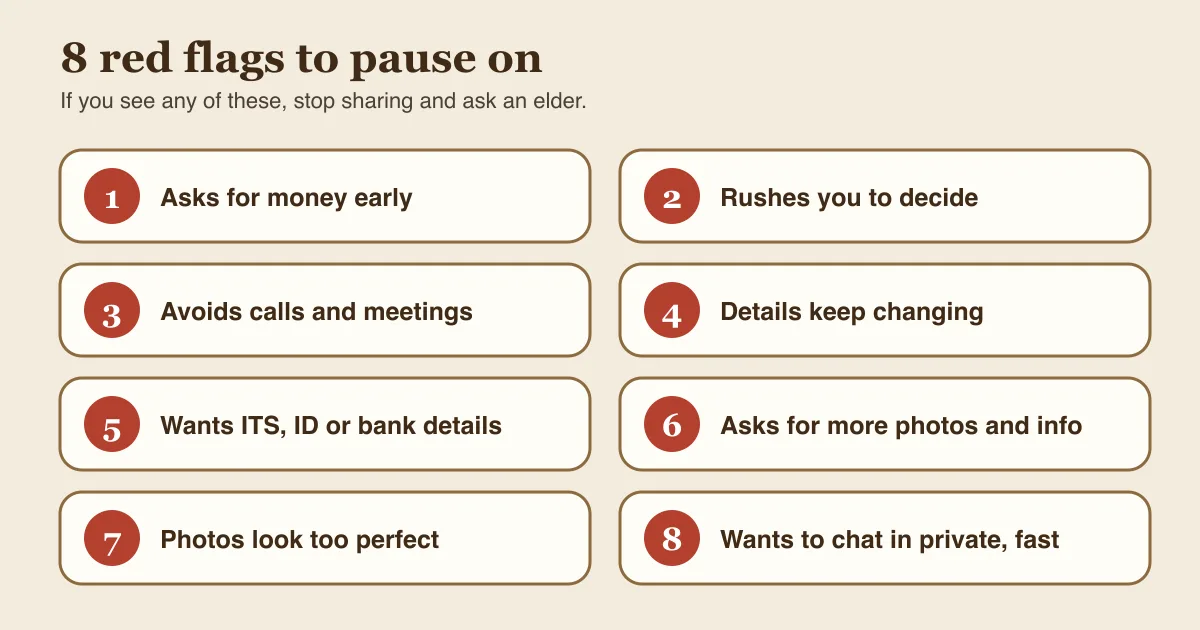
8 red flags
1. They ask for money early
A genuine family does not ask for a "registration fee", "processing fee", a gift, or help with an emergency before you have even met. Any request for money in the early stage is a stop sign.
2. They rush you
"Decide today." "Another family is waiting." "The offer ends tonight." Real decisions in a family take time and many conversations. Pressure is a tactic, not a timeline.
3. They will not speak on a call, or meet with family
Everyone can be shy in the beginning, but a family that avoids every call and every meeting, with a new excuse each time, is hiding something. A first conversation with elders present is normal, and a good sign.
4. The details keep changing
The age, the job, the city or the family story is slightly different each time you ask. Honest people remember their own life. Write down what you are told and compare it later.
5. They ask for your ITS number, ID or bank details
Nobody needs your ITS number, ID card or bank details to start a conversation. Keep them out of every biodata and never type them in reply to a stranger. (Our guide to the Bohra biodata format lists what to leave out.)
6. They ask for more photos and personal details than you gave
If you shared a photo and a short biodata and they push for more pictures, your home address, your daughter's daily routine or her social media accounts, say no. Share more only when you trust the person and a family elder agrees.
7. The photos look too perfect, or too familiar
A photo that looks like a model's, or one you feel you have seen before, may have been taken from somewhere else. You can check with a reverse image search in your phone's browser. If the same photo appears under another name, step back.
8. They want to move the conversation somewhere private, fast
A request to leave the family group and chat privately, or to switch to another app straight away, is worth noticing. A genuine contact does not mind a chat that elders can see.
What to do if you see a red flag
Stop sharing. Do not send more photos, documents or details.
Tell one trusted elder. Two sets of eyes are better than one.
Do not argue or pay. You do not owe an explanation to someone asking for money or pressure.
Save the messages in case you need to show someone later.
Block and report the contact in your chat app if you are uncomfortable.
If your own biodata has already travelled further than you wanted, read what to do if your biodata was forwarded.
Share less in the first place
Many of these problems start with how much information left home in the first message. Fewer details means fewer things to misuse.
The Smart Taaruf Card is built for this. It is your biodata as a private link instead of a file: you choose what shows, your phone number, email and ITS number are never shown, your photo is blurred by default, you can see how many times it was opened, and you can switch it off whenever you like. It is free for every family.
An honest note: no tool can make a screenshot disappear, and no tool can tell you whether a person is honest. Careful questions, family involvement and patience still matter most.
Questions
How do I check whether a family is genuine? Speak to them on a call with elders present, ask for details in more than one conversation, and ask people in the community who may know them.
Is it rude to ask questions? No. A genuine family expects you to ask, and will not mind.
Should I ever send money to someone I have not met? No. This is the single most important rule.
More about privacy and how Bohra Taaruf works? Read the FAQ or How It Works.